Private View – Earth is Calling

PRIVATE VIEW
on Thursday 24 October, 6pm – 9pm
at The CRYPT GALLERY
165 Euston Rd, Bloomsbury, London NW1 2BA

Located in the crypt of St Pancras New Church
(access to the gallery along Duke’s Road, 2nd gateway)

Meet the artist – refreshments provided
We look forward to seeing you there

FREE EVENT
Exhibition times: 23 Oct – 3 November 2019 – 11 am – 7 pm

EARTH IS CALLING
Exhibition of new work by IRMA IRSARA
Featuring soundscapes by Jonathan Lambert

The focus of my work has shifted to invisible nature, micro pollution and micro fibre plastic, using micro-photography / film to produce my outcomes.

Earth is Calling reflects on the issues through a series of fibre art pulp works, contrasting natural, organic material with man-made plastic fibre. The artist will also present time-lapse and micro time-lapse works of melting ice embedded with natural and man-made items sourced from various locations (including along the Thames foreshore). The accompanying sound was created by musician and soundscape artist Jonathan Lambert.

The gallery, in the Crypt at St Pancras Church, is one of London’s most unique and atmospheric exhibition spaces. It’s located in the centre of London right opposite Euston Station
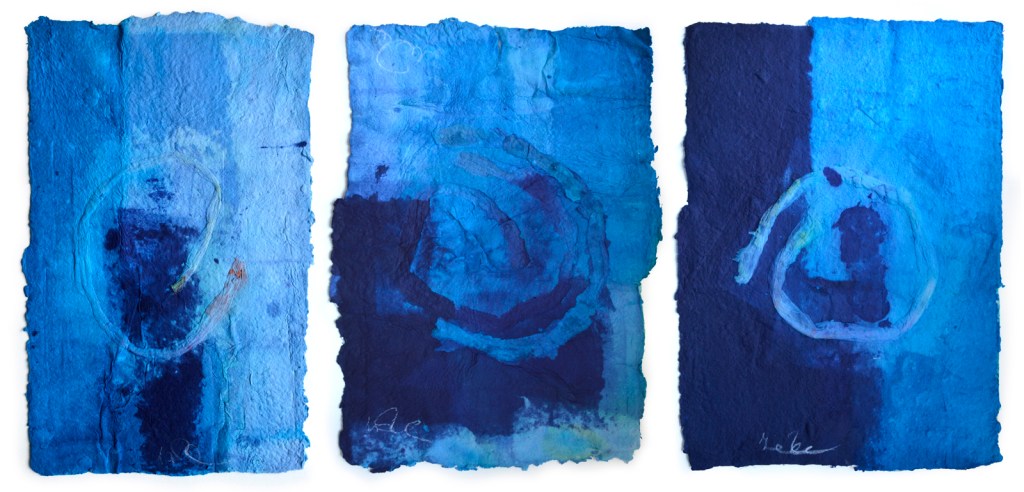
Il gioco della fontana (each piece approx 54 x 33 cm) 2018 triptich

Monster Soup 2019

Still from time lapse video work Monster Soup 2019

Monster Soup 2019 uses samples from different locations along the river to create projected time-lapses of melting frozen Thames water embedded with items found along the foreshore. A second microscopic time-lapse work shows what’s normally unseen with a focus also on micro fibre plastic and its potential impact on the environment. The accompanying sound track was created by musician and soundscape artist Jonathan Lambert.

In my work, I have always been preoccupied with nature and the environment, in large part due to my upbringing in the Italian Alps. Recently, my attention has shifted to issues concerning invisible nature, micro pollution and micro fibre plastic. My work explores ideas of transformation and adaptability in response to changes in temperature, landscape, boundaries, and the natural cycle.

The work will be shown at:
FORAGERS OF THE FORESHORE (Totally Thames Festival)
Bargehouse, Barge House Street, SE1 9PH
Wed 25 – Sun 29 Sep, 11am – 6pm

https://totallythames.org/event/foragers-of-the-foreshore


Dale Fort Field Trip

As an artist, my final outcomes don’t claim to be research. They do aim to frame my area of interest as part of the climate change narrative in an non scientific way while referencing some of the recent findings. At the same time, I value the opportunity to engage with members of the scientific community and to participate in field study trips with groups such as the Quekett Club.

My current area of exploration is microfibre plastic.  I’m interested in the plastic that ‘disappears’ from the waste stream by being broken down into smaller and smaller particles. The problem now is not only how to reduce production of plastic but how to manage what’s already there – recycling just moves the problem along.

One area of concern is the presence of micro plastics in the ocean and it’s ingestion by organisms right down to plankton at the bottom of the food chain. Clothes made from synthetics are one source of microfibre plastics found in rivers, lakes and oceans. Millions of microfibres are released every time we wash these materials.

https://www.bbc.co.uk/news/science-environment-39217985
https://friendsoftheearth.uk/plastics/microfibres-plastic-in-our-clothes
https://www.theguardian.com/sustainable-business/2017/jun/29/microfibers-plastic-pollution-apparel-oceans

On a recent field trip to Dale Fort on the  Pembrokeshire coast, I was interested to see what I could find on the shoreline and in the water. There is the usual larger plastic items which ultimately will break down.

Looking at plankton using 10x and 20x lens – so showing slightly bigger examples -indicated fibres from fishing netting and plastic rope as would be expected.


Keyence VHX 5000 Microscope

Thanks to Matthew Armes, technical sales engineer for Keyence UK, who called round on Thursday to demonstrate the VHX-6000 Digital Microscope.

This is incredibly easy to use and is capable of real-time focus stacking.

Multi-angle observation by rotating the stage or tilting the lens up to 90 degrees means you don’t have the move the samples by hand. It produces images up to 1600 x 1200 – for higher res, automatic stitching is possible with the motorized stage.

Also good depth of field, embedded polarizing lens and really fast automatic focusing.

I had the opportunity to photograph some of my micro fibre plastic slides, melted snowflake and ice slides and lichens.

Images from clockwise: synthetic net bag for fruit produce, synthetic tights, melting ice, dried Lobaria Pulmonaria x 2, melting ice

Art in Health

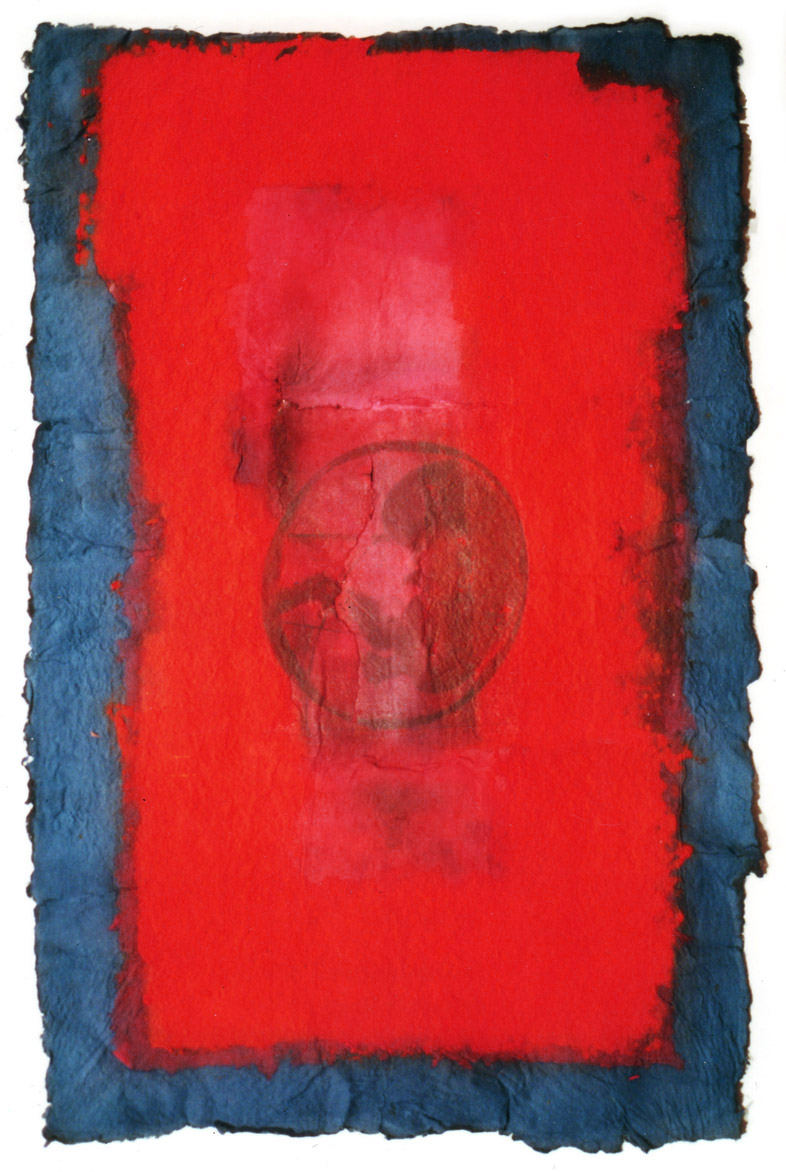
Meravigliare il Rosso used on the cover of Psychoanalytic Theory for Social Work Practice: Thinking under Fire by Marion Bower (2005)

A recent proposal led me to think about art in health settings. I’m very aware of the importance of art in these types of surroundings both from my experience as a patient who has benefited from the presence of uplifting work and as an artist who has shown work in similar settings.

Joanna Wakefield, Art Director at Art St George’s, believes that abstract art is a particularly powerful medium to enable patients and staff to find their own narratives, noting that the nature of the art within their collection is purposefully without subject bias, whilst leaning away from dark colours and macabre scenes towards bold, textured abstract works with plenty of room for interpretation and reflection.

My own work takes its inspiration from specific themes and subject matter but the finished work is generally abstract. I have work in the permanent collections of the BMA building in Tavistock Place and the Tavistock Clinic where I’ve exhibited a number of times in the past. I’ve also displayed my art at the Wandsworth Medical Centre and it has been used in visualization sessions for relaxation and meditation at the NHS Trust’s Bristol Breast Care Centre.

Corridor gallery at the Tavistock Centre

I’m conscious of the power of artwork to calm and uplift; to alter and enhance an environment and change an individual’s mood through colour. I’m deeply interested in the relationship between colour and state of mind. I’m conscious of the calming influence of blues and the potential of colours such as carmine red and jaune d’or to interact in a stimulating way to reinforce feelings of positivity. Art has the capacity to effect a different state of mind and transport the viewer somewhere else albeit for a brief moment in time.

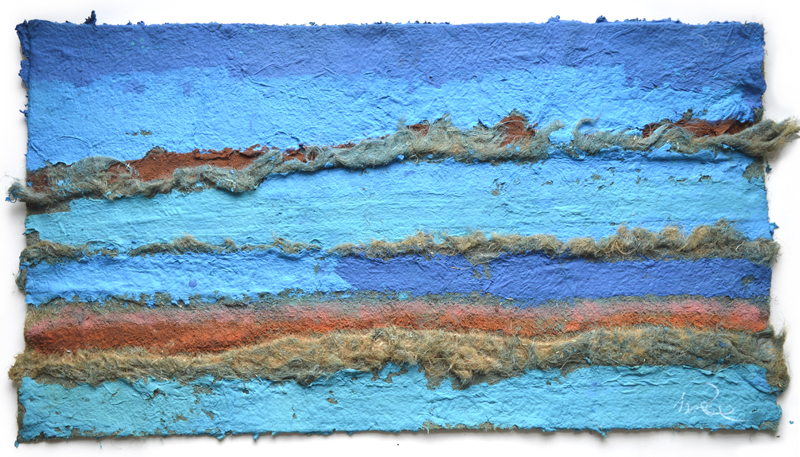
My practice encompasses a broad range of media and techniques with the ‘pulp work’ (examples shown) represent a large part of my recent output. The uneven edges of the final work is very important to me as it breaks down the border between the picture and what lies beyond. It enables the work to define a space and become part of the surroundings rather than being a series of contained images.

Rivelare (Reveal) 63 x 105 cm – cotton fibre, pigment dyes, hemp, sand 2018

QUEKEX 2018

Captured irregular snowflakes (London 2018) on slides, one of which shows microfibre plastic which could be clearly seen during the melting process. It’s worth asking what sort of damage plastic fibres are doing.

Photos will be shown at the Quekett Microscopical Club Quekex exhibition at NATURAL HISTORY MUSEUM (foyer of the Flett Theatre), Cromwell Road, London SW7 5BD
Saturday 6th October 2018, 10.30am – 4pm
Invitation-only exhibition.