Working as a Woman Artist

Reflections on Working as a Woman Artist:
talk and visuals by Irma Irsara

DATE AND TIME: Thursday March 8 – 6:00 PM – 8:00 PM
LOCATION: Resource For London, 356 Holloway Road, London N7 6PA (map below)
BOOK TICKETS (free):
https://www.eventbrite.com/e/reflections-on-working-as-a-woman-artist-talk-and-visuals-by-irma-irsara-tickets-43618971518?

DESCRIPTION
Italian artist Irma Irsara has chosen International Women’s Day to talk about her experiences as a woman artist during a career that spans over 30 years. The event is being held in conjunction with her current exhibition at Resource for London: ‘Zero Celsius – Digital Prints’.

Irma will share her thoughts on growing up in a male dominated environment, the impact of gender politics on her time at the Accademia di Belle Arti in Urbino, and the current position of women artists in the art establishment.

She will reflect on her experiences, both positive and negative, with galleries, collectors, art consultants and art fairs, as well as exploring the idea of going the solo route versus connecting with peers through collectives. She will explore how the urgency of wanting to create art conflicted with the practical side of the business. She also had to re-think her practice after the birth of her children and considers the effect of motherhood on both the content of her art and her working practices.

Irma Irsara grew up on the foothills of Monte Croce in the Italian Dolomites and her work is heavily influenced by the natural environment. She has a special interest in ecology, conservation and climate change. As well as her artistic training at the Accademia di Belle Arti di Urbino in Italy, she studied Country Care and Conservation at Capel Manor Horticultural College in Enfield. Her practice encompasses a broad range of media and techniques, with ‘pulp work’ representing a large part of her recent output. She has lived and worked in London for many years and exhibits both in the UK and abroad.

Resource for London is where the voluntary sector comes to work, meet and exhibit. Owned by Trust for London and managed by the Ethical Property Company, all proceeds stay within the voluntary sector and are used to support groups tackling inequality in London while the Centre is managed to high environmental standards.

Zero Celsius – digital prints

My current exhibition is at Resource for London, 356 Holloway Road, London N7 6PA until 27th March ’18 – exhibition statement below.

“The transparency of the material leads me to look closer, almost searching for and imaginary landscape inside the heart of the ice. I find ice is very similar to other materials I have used in the past like glass, mirror and pulp. When light enters the artwork, it makes the edges more defined and frees the boundaries between artwork and the surrounding space.”

Irma Irsara‘s work is influenced by an interest in environmental issues in a practice that embraces techniques as diverse as fibre art, stained glass bookmaking, print, video and installation. Within the context of the Anthropocene Epoch, where human activity has been the dominant influence in altering the geographical landscape, Irsara contemplates ideas of  symbiosis as a strategy for human survival. The symbiosis of organic materials with the ice is particularly significant. It is the moment when nature takes over and the artist becomes the observer of new forms.

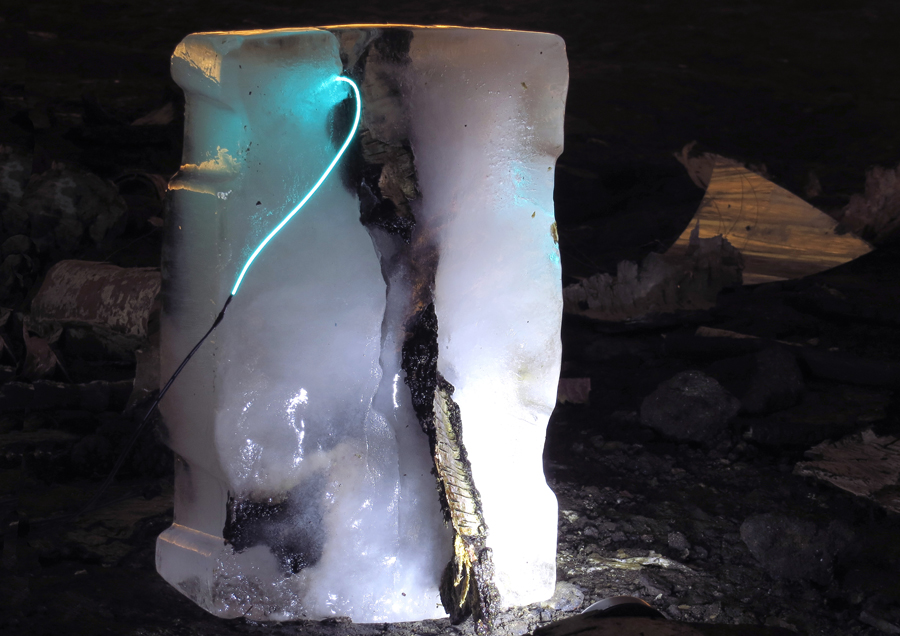
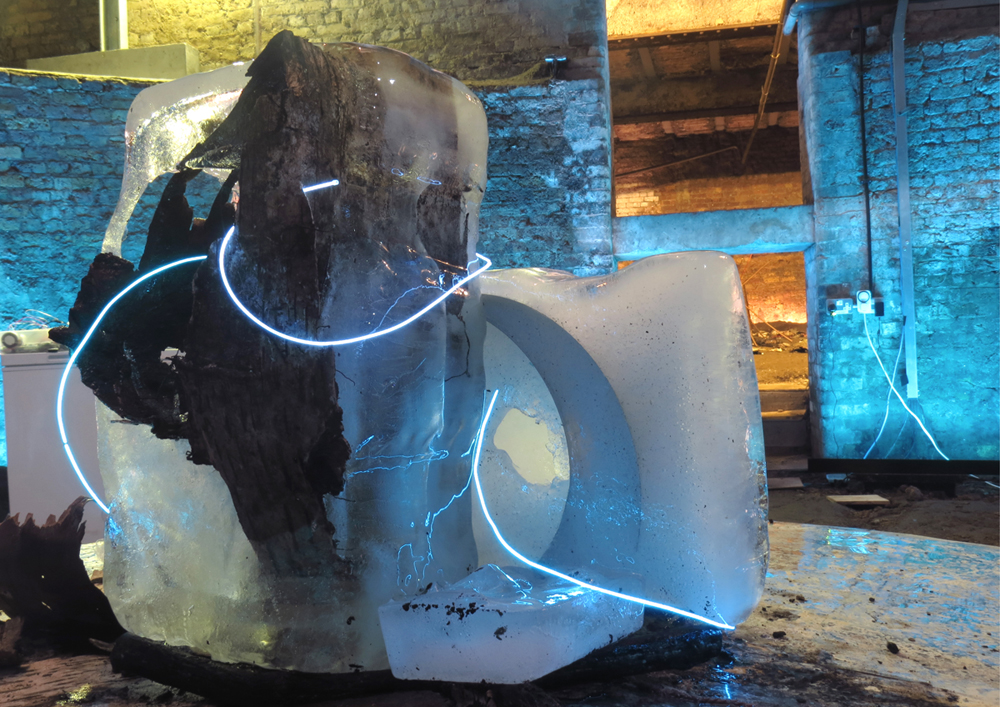
The digital prints on display are a permanent record of the time-based, site-specific installation work created by the artist in 2013/14. This constantly changing and daily-renewed work was produced over a three week period in the former Victorian ice wells at the London Canal Museum, King’s Cross. Working with ice, a material very much associated with the theme of climate change, the work explores natural cycles and outcomes in relation to surrounding conditions and is intended as a starting point for debate. She has a fascination with the medium, from the fusing together of forms to the slow, imperceptible movement of embedded material – bark, melinex, wire lights – as the melting process progresses. She also examines the possibility of producing hollow forms of ice by utilizing the natural freezing process. This is further explored in her more recent time-lapse pieces. Irsara is intrigued by the notion of a precise moment of transformation and change of state.

Drawing a Line Under Torture

Drawing a Line Under Torture, Freedom from Torture‘s biennial charity art auction takes place 8 November 2017 – 12 November 2017 at Bargehouse, Oxo Tower Wharf, South Bank, London

To bid on the work below and many other pieces, please follow the link:
http://ow.ly/6pCf30g8Ona

All works will continue to be on display until the close of the public exhibition and will be available for collection from Tuesday 14 November 2017

Freedom from Torture is a UK-based human rights organisation, and one of the largest torture rehabilitation centres in the world; it is the only specialist national charity working to ensure the rehabilitation and protection of torture survivors seeking refuge in the UK. Since it’s establishment in 1985, more than 57,000 survivors of torture have been referred to us.

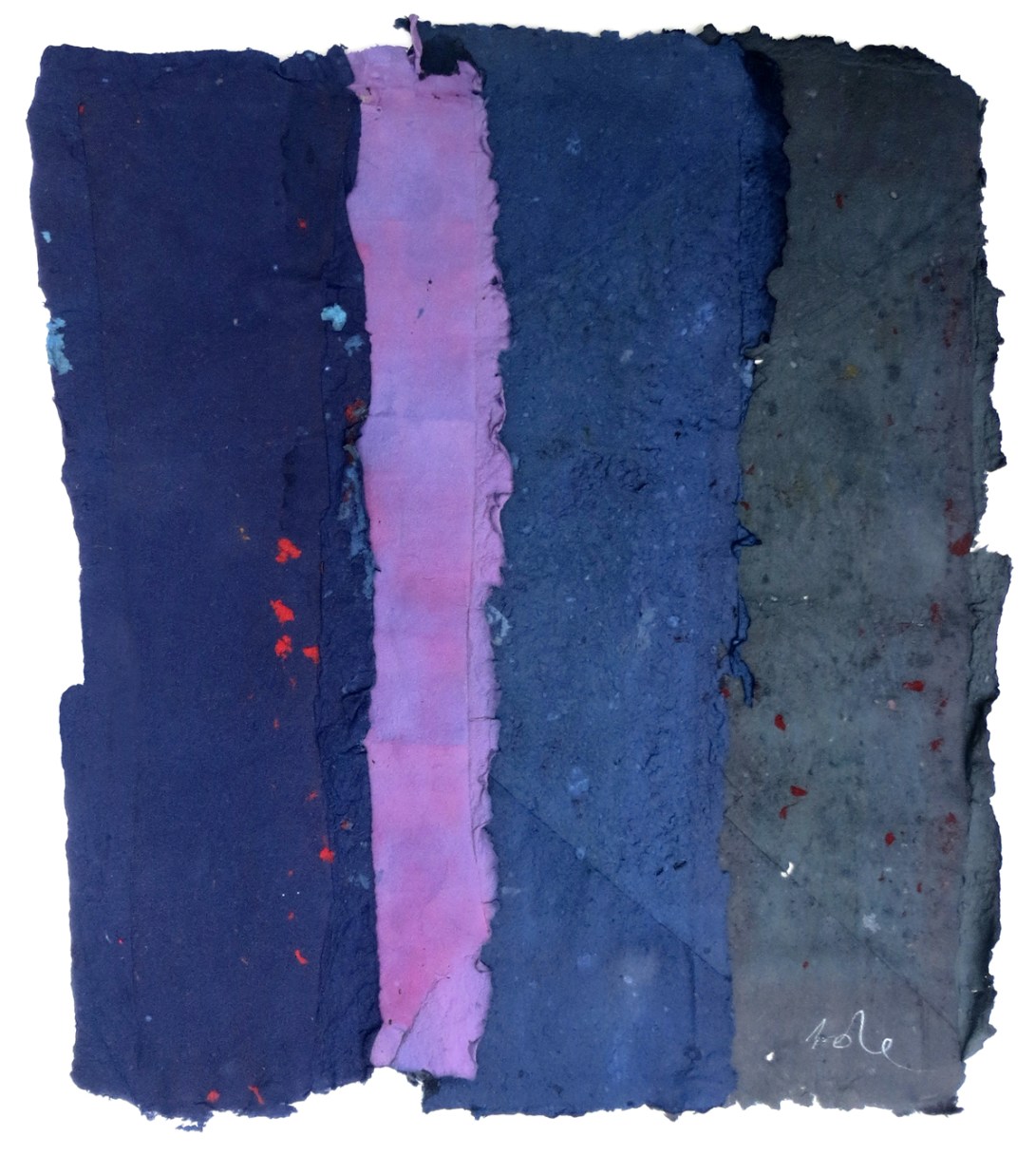
Fonte (Fount)
Cotton fibre pulps, direct dyes
52cm x 47cm
2017
Guide Price: £760
Framed

Irma Irsara’s work is heavily influenced by the natural environment in which she grew up – the foothills of Monte Croce in the Italian Dolomites. She has a special interest in ecology, conservation and climate change. ‘Fonte’ reflects an early childhood moment in a place revisited but now changed due to the effects of stream erosion. The title refers not only to rising water through cracks in the bedrock but also the idea of innocent thought set against the backdrop of succeeding stages of life.

Irsara’s practice encompasses a broad range of media and techniques with the ‘pulp work’ representing a large part of her recent output. The wet-on-wet process involves building up strata of dyed pulp which can be further modified through embedding, sculpting, ripping, embossing etc. She exhibits both in the UK and abroad.

Analytical aspects of conservation

It was a privileged to meet Christine Sitwell, the National Trust paintings expert at her talk, Analytical aspects of conservation in painting, organised by The Quekett Club in the Natural History Museum yesterday. It was fascinating to hear her speak about the process of attribution in relation to the Rembrandt self-portrait at the National Trust’s Buckland Abbey in Devon.

Christine talked about how technology is used to identify different periods through examination of different layers (ground), pigment and varnish. Minute specs of paint – usually taken from a tear or from the side – are examined under the microscope. She talked about the value of real pigments (various periods) and the use of spectronomy to pinpoint elements such as pigments, cobalt, potassium, nickel, smelt.

I very much hope that they can also authenticate the Titan as the one missing from the series.

Fibres and Pigment

The natural light plays a big part in the pulp art process. Drying in the open air in the right sunny conditions helps the chemical reaction between pigment and fibre resulting in stronger, high-density colours.
The stronger the natural light and the longer it’s been left to dry, the better it is in terms of the pigment being absorbed by the fibre (usually 3 to 4 weeks).


l’incisione

Riguardando i lavori di anni fa, ricordo le tecniche iniziate assieme col grande maestri dell’incisione Bruscaglia e Bertoni, professori all’Accademia di Urbino quando io ero studente. A Londra, ho poi ripreso l’incisione negli anni 90 nei workshops di Ormond Road.

Donna con camoscia Irma Irsara 1990

Collegando e rivisitando sempre i miei lavori di prima, vedo come mi è molto importante tutto quello che ho fatto prima per la mia formazione artistica e per inventare sempre nuove possibilità per nuove  opere.

La sovvraposizione delle lastre e l’uso di solo due colori mi affascina ancora. La tecnica del sugarlift e open-bite dona una libertà simile al dipingere ed è molto utile per indicare ombre e graduazioni gentili per la composizione e tema. La possibilità di multeplici dell’incisione-stampe fatte con le mani da me ha un fascino tattile che non si dimentica facilmente.

Ora la ricerca è diventata quella lontana prospettiva all’infinito – l’orrizzonte che non ha mai fine.

I currently have a small selection of framed etchings for a limited time and at very affordable prices at:
Libertea Cafe, Unit G-12, 159-163 Marlborough Road, London N19 4NF
Details, including opening times, can be found on YELP.

Rotherhithe

A visit to Canada Water Library at the end of last week gave me the opportunity to take photos along the stretch of the Thames between Brunel Museum to Tower Bridge

Ritornando dalla biblioteca ‘super library’ di Canada Water e caminando verso il fiume, ammiro il riflesso dell’architettura in evoluzione attraversata dal presente, passato e futuro. Questo giorno il Tamigi era ormai sommerso dalla nebbia e qui riscopro la mia Venezia in inverno.

Mi chiedo se l’architettura vista davanti funziona in armonia con la natura solo nella nebbia?

Fissando l’acqua grigia del Tamigi, rifletto sulla praticalità del mio nuovo progetto che eventualmente diventerà opera – monster soup del 2017.

Zero Celsius DAY 13 – 02

ZERO CELSIUS

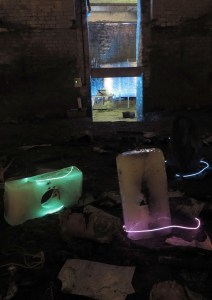
Victorian Ice Wells, London Canal Museum, King’s Cross  –  Non-permanent, ever-changing, time-based ice installation

Materials:
Ice (created from canal water on site each day using three top loading freezers from), 1.3mm El Wire, different lengths powered by mains and battery packs (for embedded lights), Melanex shapes, Silver birch bark sourced from fallen trees source restored to original location at the end of the project. Charcoal made from pruned vine branches.

Dimensions variable.

Zero Celsius was an opportunity to witness, explore and be part of an unexpected subterranean landscape in the heart of King’s Cross. Through investigation and elaboration of different elements embedded in blocks of ice, artist Irma Irsara developed an experimental work with ever-changing outcomes. The installation process was determined by the interaction between the artist, the unique host location and the melting shapes of ice, resulting in a unique participatory experience.

www.zer0celsius.wordpress.com

Charcoal Text 1

I Irsara Charcoal Text 1 sml

CHARCOAL TEXT 1

medium:
digital print of ice, burnt wood and shredded text
Epson archival inks on Somerset Velvet 300gsm paper

size in cm: 59.5 x 84
printed at London Print Studio, Harrow

Charcoal Text 1 is a part of a series produced for the publication Halse for hazel, a sequence of poems about trees, their languages and forms by Frances Preslsy. The collaboration took place during the final year of Presley’s project funded by the Arts Council and included research at the national collections of Kew Gardens and Wakehurst Place. The large-scale versions of the images and texts were used for the subsequent exhibition ‘In the open’, at Murray Edwards College in Cambridge (2015)