Tidal Traces

I’m very proud to be one of the featured artists for Totally Thames 2023 (Thames Festival)
This year, I’ll be exhibiting at The Old Operating Theatre Museum and Herb Garret throughout September. Tidal Traces draws attention to issues relating to the River Thames through a series of free-hanging installations, time-lapse video and family workshop.
As well as a chance to see my current work, this is an opportunity to see an atmospheric museum that offers a unique insight into the history of medicine and surgery.

THE OLD OPERATING THEATRE MUSEUM
AND HERB GARRET
9a St Thomas St, London, SE1 9RY


In addition to the exhibition, I’ll be holding an evening screening of three video works with Q & A (19th September 6.00 – 8.15pm) where you will also have the opportunity to see the installation and museum for free. Tickets are limited for this so I would urge you to book only if you are definitely attending.

Entry to the exhibition at other times does not require booking but is subject to the museum’s normal admission charge.


OPENING TIMES AND DATES

Fri 1st – Sat 30th Sep 2023

10:30am – 5pm

Museum opening times:
Thursdays, Fridays, Saturdays and Sundays, 10.30am – 5.00pm (last admission is 4.15pm)

Drop-in family workshop:
Sunday 3 September 2023, 11am – 4.30pm
available with paid entry to the museum

Accessibility Guide

TICKETS

Entry price to the museum for exhibition and workshop

Adult: £7.50
Concessions: £6.00
Child 6-16 years: £4.50
Children under 6 years: Free
Carers (with a full paying adult, concession or child ticket): Free
Family (2 adults, 2 children): £18.00, additional child, £1 each

Tidal Traces is supported by
Totally Thames, Team London Bridge and The Old Operating Theater and Herb Garret
TIDAL TRACES

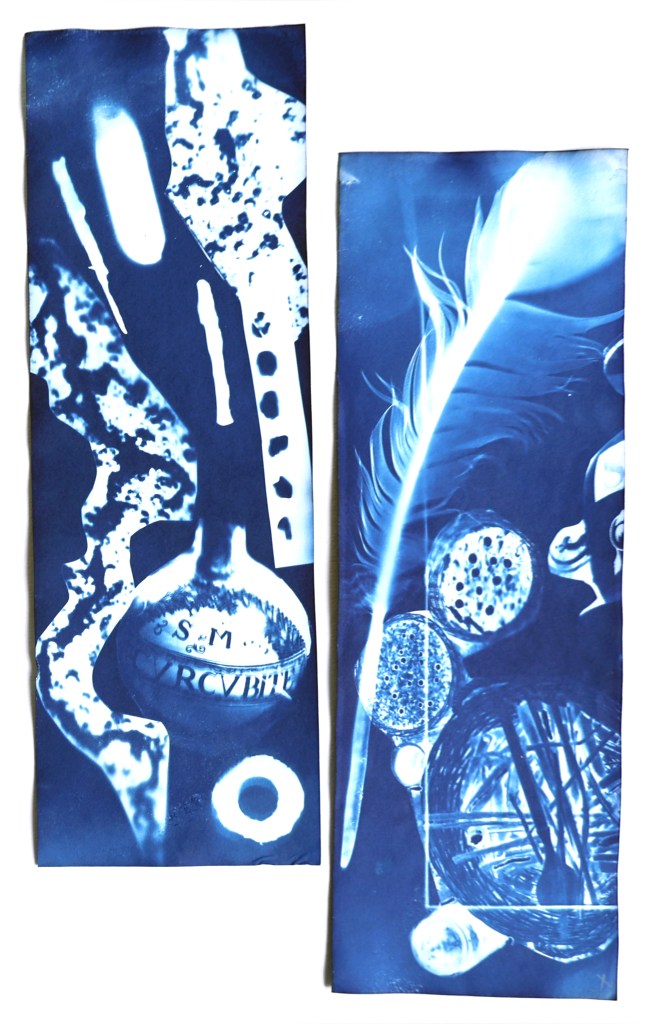
The site-specific installation, continues my exploration of environmental issues, looking at material that finds its way into the Thames through natural phenomena and human activity, and the impact on the health of the river’s eco-system and the surrounding population. Recovering debris from the foreshore at various points along the river – plastic netting, nails, sand, silt, aged wood, charcoal, algae, bones – I create work using video, cyanography, chromatography and micrography to represent both the visible and the invisible, in particular micro fibre plastic and pharmaceutical contaminants.

Multiple elements make up the final site-specific installation which, in part, looks at the pharmaceutical contamination in the river alongside the healing qualities of the apothecary herbs featured in the Herb Garret at the museum.

TIME-LAPSE VIDEO

Metamorphosis (6 min 39 sec) 2019
River Net (9 min 10 sec) 2022
Silt (6 min 10 sec) 2023

The video works, each comprised of a series of time-lapse sequences, are a reflection on our impact on the Thames, including chemical and pharmaceutical discharge into the river leading to, among other things, antibiotic-resistant bacteria.

The work is intended to encourage debate on the effects of our actions on the natural balance and how we can re-establish and maintain healthy ecosystems. I’ve used a range of materials in the creation of the videos including silt, sand and algae, as well as man-made and organic objects retrieved from the foreshore at low tide. Tidal cycles are recreated using small-scale models, shot at 25 second intervals as liquid is slowly drained away. In other sequences, ice has been used to animate the forms. The soundtrack for all videos was created by Jonathan Lambert.

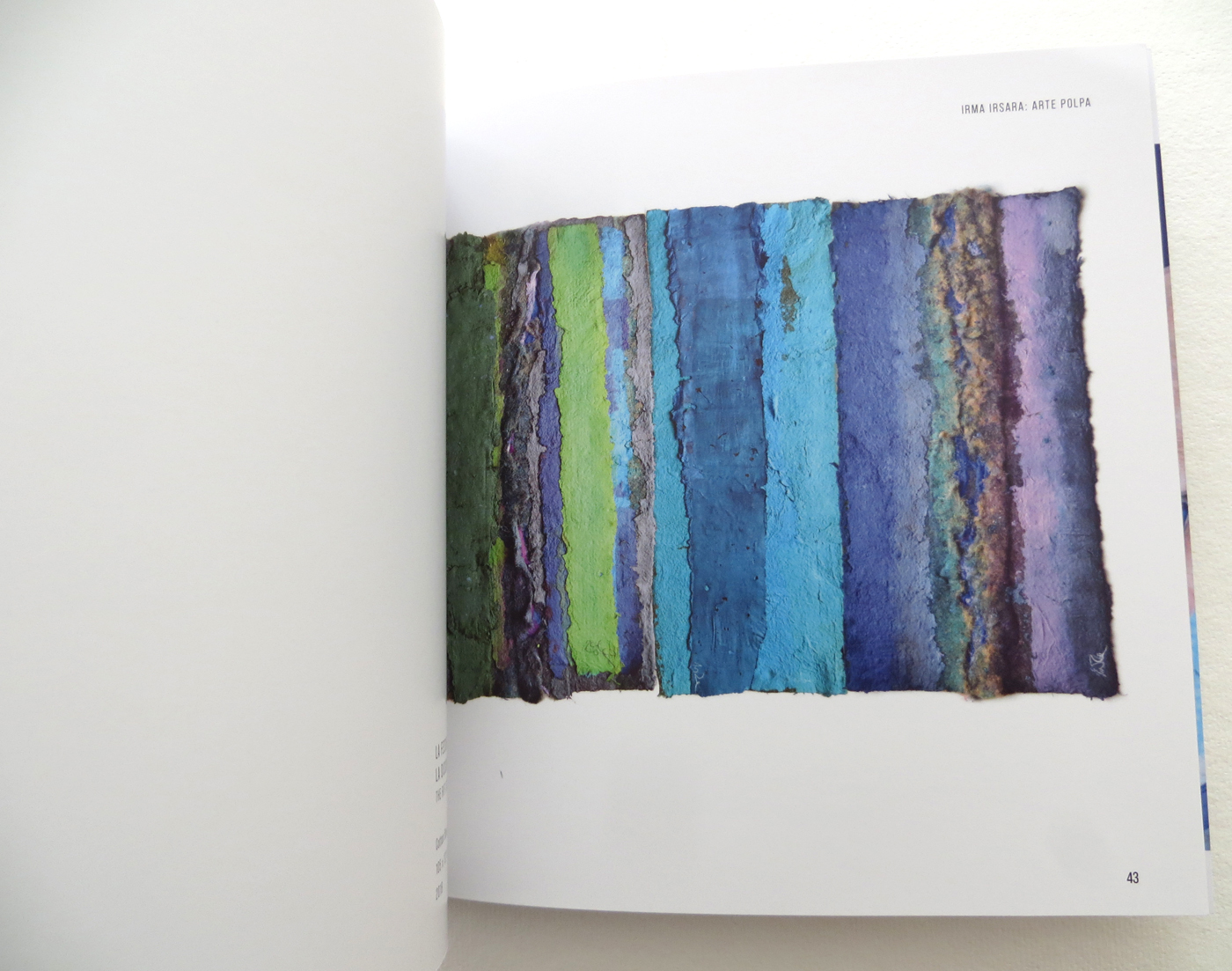
Arte Polpa – Irma Irsara

Arte Polpa – Irma Irsara
Catalogue of selected paper pulp works from 2006 – 2020

soft cover / 210 x 210 cm / 48 pg / design by Decoder

with introduction by Claire McCaslin-Brown

Some copies still available from 
https://irmairsara.bigcartel.com/product/arte-polpe-irma-irsara-catalogue-of-paper-pulp-works

A FRUGAL, NATURAL ART: “ARTE POLPA”

There is a vibrancy to the work of artist Irma Irsara (b.1961, Italy). Shades of bright red, turquoise and blue draw the eye towards the natural materials onto which pigment dyes are embedded. Remnants of pure cotton cloth and fallen bark are incorporated into bold statements of abstract colour. Stand before these images and you experience an energetic force that evokes at once curiosity and contemplation.

Irsara explores issues concerning our natural environment and the way in which we are connected to it. Her lyrical abstract compositions are formed out of found organic materials such as waste cotton fibres and storm debris that she picks up on her travels and intuitively transforms into a vibrant mix by adding pigment dyes in a sort of magical alchemical process.

Inspired in part by the works of the Italian “arte povera” movement of the late 1960s and 1970s, these organic materials are at the core of Irsara’s art and similarly make reference to the natural environment, acting as a statement against mass-market consumerism. Irsara favours the essential nature of life as those artists did through their choice of worthless materials such as bits of wood, rags and scraps of newspaper from where the actual creative process has more significance than a finished object. Irsara rejects the consumerist product in favour of a raw-edged, natural, unfinished art that evokes the real, the instinct and the ephemeral.

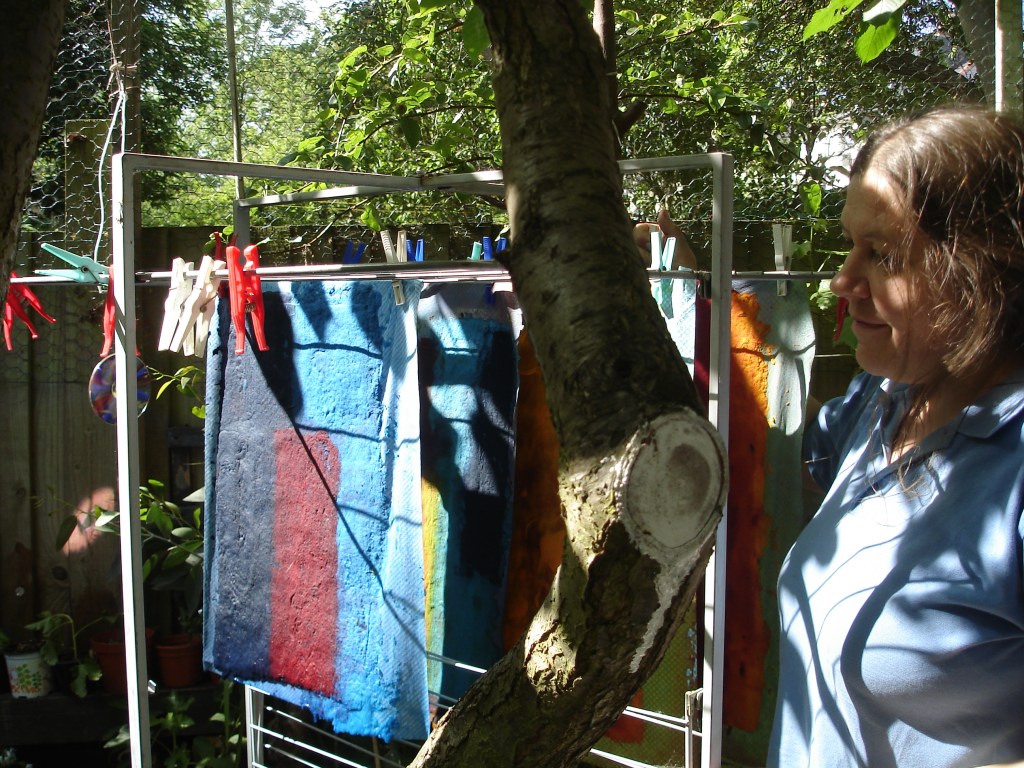
Colour is key to Irsara’s work, and though flat, there is a depth to these abstract works. The eye is drawn into the essence of the work and yet allowed to drift along the rough contours and unfinished edges, beckoning a sort of unpredictability, reminiscent of nature itself. In contrast to the natural brown tones of the earth, the artist calculates exactly a weight and intensity of colour by using a special technique that is akin to the process of paper making. The “arte polpa” process is a term created by the artist and refers to a technique that uses layers upon layers of cotton fibre pulp, pressed down by hand, wet on wet, using a hand mould and deckle process. The artist pushes down on the natural texture of the pulp, creating batches of similar colours to create a basic palette, and to which she occasionally adds a quantity of pure, fibre-reactive pigment dyes.  

Sunlight plays a big part in the drying process which can take three to four weeks and contributes to the alchemical process between pigment and fibre that eventually produces the strong, high-density colours. The process is characterised by its simplicity and yet strength of the material. These changes in natural forms from the innate interweaving of the fibres themselves are at the core of Irsara’s work and encourage a lyrical reflection on the essence of nature and its inherent changeability. 

“I‘m drawn to the simplicity and strength of the material, its feeling of fragility and its alchemical appeal.”   Irma Irsara

Irsara sometimes incorporates overlooked detritus into her work that has been discarded carelessly, possibly left behind through natural phenomena or social activity. Her latest abstract works examine the way abandoned plastics retain their strength of colour indefinitely when compared with the organic nature of pure pigment colours and she has shifted her focus to issues concerning micro pollution and climate change. Time-lapse digital video work is another medium used by the artist to illustrate the way nature changes and amplifies the immersive experience that includes colour, abstraction, video and sound when viewing Irsara’s works. The abstraction of texture, colour and form challenges the viewer to share in the conveyance of an experience, an invitation to contemplate, to really observe nature and to see beyond with the inner eye, the conversation that is art.

Claire McCaslin-Brown, 22 May 2022

Art Adviser

www.mccaslinartadvisory.com

Hidden Femininity


The collographs features in this post, based on ethnic garments, were part of a series created for my exhibition Hidden Femininity (Filef Centre 1996). They were developed during my collaboration Automatic Cross Stitch with poet Frances Presley, which looked at the rag trade in North London (N4) run mostly by Greek and Turkish owners.

I was interested in hidden women workers, working illegally in the garment industry in North London during the early nineties. I focused on those working in the factories in and around Finsbury Park mostly run by Turkish and Greek families. In order to gain access, I worked in one of the factories for a number of weeks cutting the loose threads off the finished garments.

I would often see women who couldn’t afford childcare bringing in their babies to work and hiding them from view in their work area. I observed one woman taking secret breaks to breastfeed her child. They were also instructed to disappear if the inspectors arrived.

The women I saw were mostly Indian and Eastern European who relied on the work for their survival and whose circumstances resulted in their exploitation.

The factories have disappeared from the area due to regeneration.

Details of the artworks:
available from irmairsara.bigcartel.com

Cintura (belt) 1996
Collograph using material (factory off-cuts), card with stitching, coloured tissue, rolled colour (oil).
One of three variations from the same card plate, so each one unique.

Print size: 12.5(H) x 30(W) cm
Paper size: 19(H) x 35(W) cm

Punto riso per una sposina (Rice Stitch for a Bride) 1996

One-colour embossed collograph (card plate) of a child’s knitted jumper.
AP1 Artist proof 1 of 2 variations / no edition

print size: 21(H) x 48(W) cm
paper size: 28.5(H) x 57(W) cm

Guanti per sposina (Gloves for a Bride) 1996

One-colour embossed collograph (card plate) using wedding gloves.
AP2 Artist proof 2 of 3 / no edition

print size: 31(H) x 22(W) cm
paper size: 44(H) x 27(W) cm

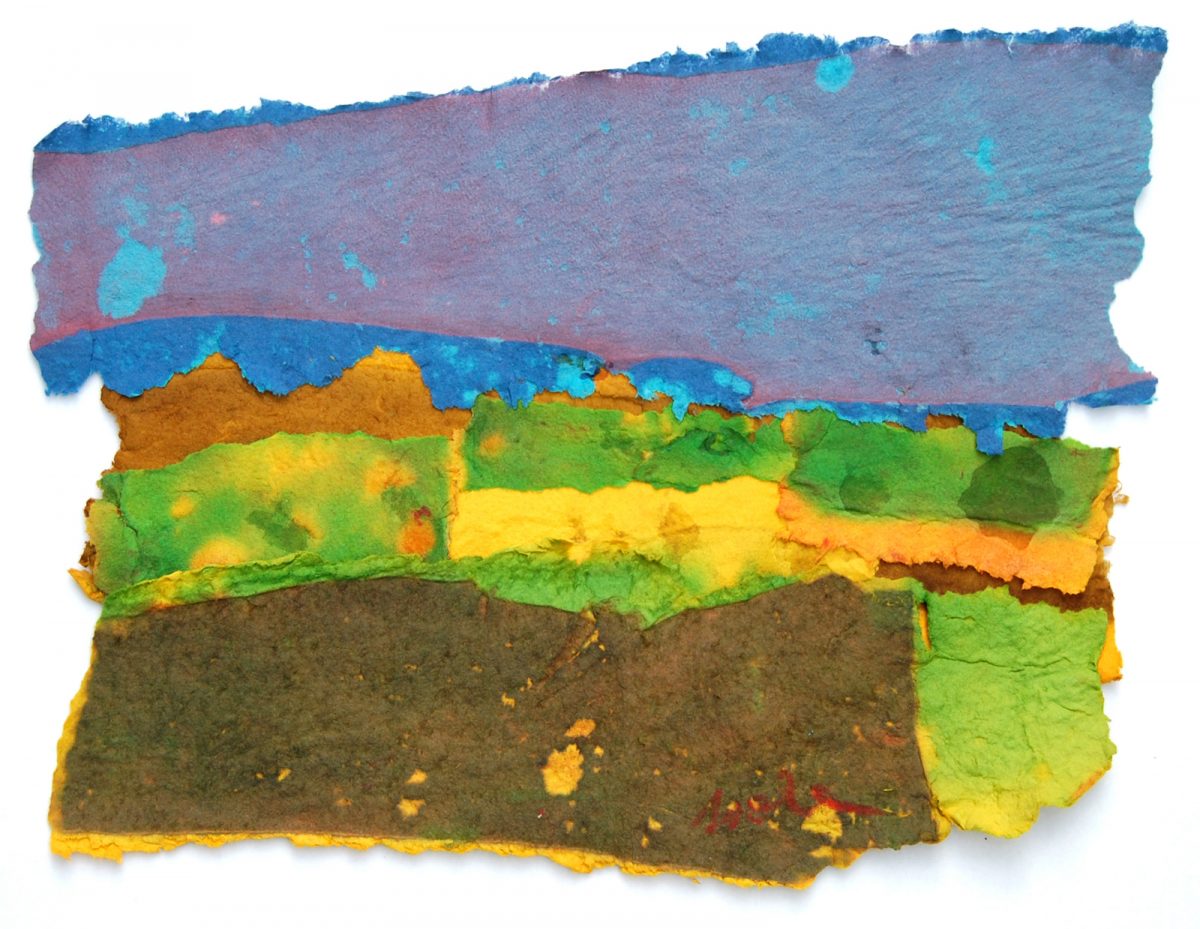
Aerial landscape 5

Aerial landscape 5 (2013) represents a view of Sussex showing a landscape delineated by boundary and colour where land meets sea.
The yellow of the rapeseed fields and light greens and browns are divided by the precise man-made geometry of dark green hedges.
I used re-cycled dyed leather where I transferred the colour onto the wet cotton pulp in order to fuse it with the existing pigment dyes.
The result is a work imbued with a feeling of nostalgia, a look back at the past from a position of borrowed time.

cotton fibre, pigment dyes
H 28 x W 36 cm

This work is available to buy from:
irmairsara.bigcartel.com/product/aerial-landscape-5