Soundscapes

The soundscapes for the three time-lapse video works in the current exhibition at the Crypt Gallery, Earth is Calling, were created by musician and composer, Jonathan Lambert. In our initial conversation I gave him my thoughts on the videos and how I envisaged the sound. I supplied Jonathan with a number of individual time-lapse pieces initially and he sent back his first test pieces. This became the starting point for a series of conversations and re-workings leading to the final pieces.

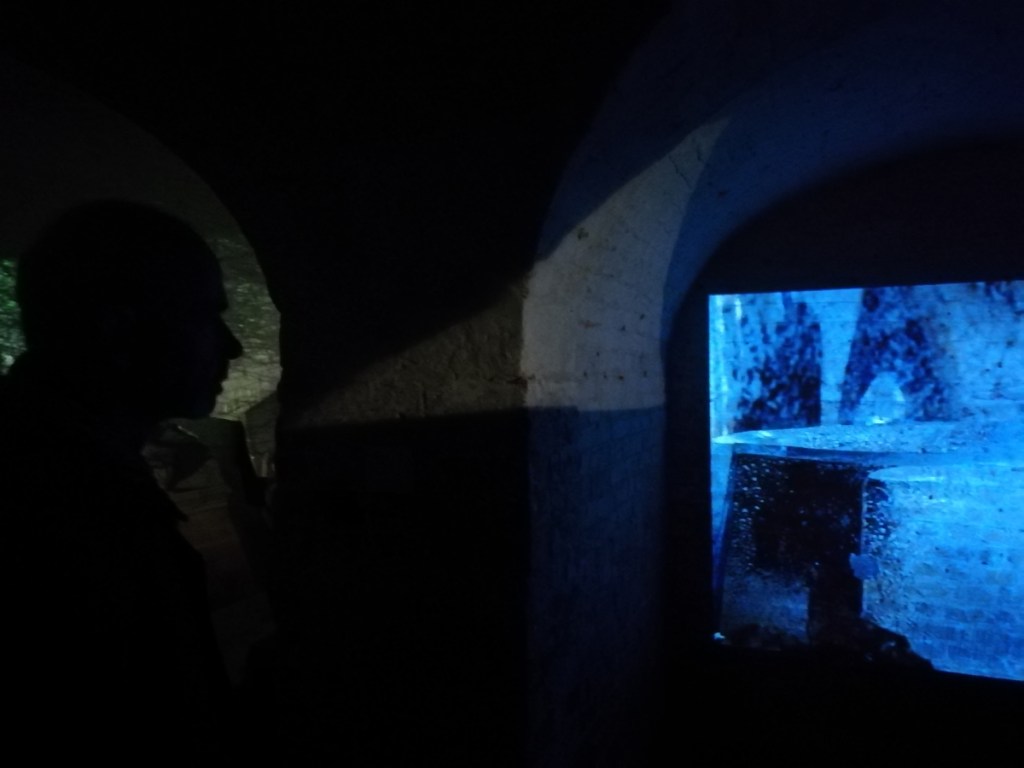
The videos are located in three places in the Crypt with the result that they merge in different ways depending on where you are in the gallery. Because the lengths of the videos vary, no combination of sounds is ever repeated. Added to the mix is the noise of traffic from the street, the occasional ringing of the bell from the church above and the faraway sound of my voice from the film playing in one of the rooms.

Jonathan has this to say about the process:

‘The first piece of Irma’s work I saw was an installation in the Canal Museum.  The desire to stay to see the process through to the end, whatever that might be, was strong, but time, human endurance and the venue’s opening hours, ran contrary to my wishes. Images suggest sound, but how to apply sound to a process which may take days or weeks to run its course?  A project involving time-lapse video was a logical step; not just a compromise between artist and public, but something new and vital.  I knew when I first saw these images that I wanted to be involved.

The juxtaposition of time-lapse video and sounds recorded in real time, especially sounds from the natural world, intrigues me.  Is time being stretched or compressed? It invites extrapolation to a geological perspective in one direction and, in the other, to that of tiny creatures which live their whole lives in a brief moment.  Where are we on that scale?

Choosing the initial palette is key when I begin any project.  I take an instinctive approach and avoid making rational decisions until I have a rough sketch.  At that point I can hear what doesn’t work and what has potential.  Once I am happy with the basic elements I can add or strip away without losing my sense of the whole. 

This work makes use of location recordings of ice and liquid water.  The musical elements offer an emotional dimension to an engagement which might otherwise be wholly cerebral and dispassionate. I wanted only to open that emotional door, not furnish the room within.  Yet while I have no wish to dictate the quality of your response, my hope is that your connection with the images goes beyond a superficial interest.

www.lamsound.com

Private View – Earth is Calling

PRIVATE VIEW
on Thursday 24 October, 6pm – 9pm
at The CRYPT GALLERY
165 Euston Rd, Bloomsbury, London NW1 2BA

Located in the crypt of St Pancras New Church
(access to the gallery along Duke’s Road, 2nd gateway)

Meet the artist – refreshments provided
We look forward to seeing you there

FREE EVENT
Exhibition times: 23 Oct – 3 November 2019 – 11 am – 7 pm

EARTH IS CALLING
Exhibition of new work by IRMA IRSARA
Featuring soundscapes by Jonathan Lambert

The focus of my work has shifted to invisible nature, micro pollution and micro fibre plastic, using micro-photography / film to produce my outcomes.

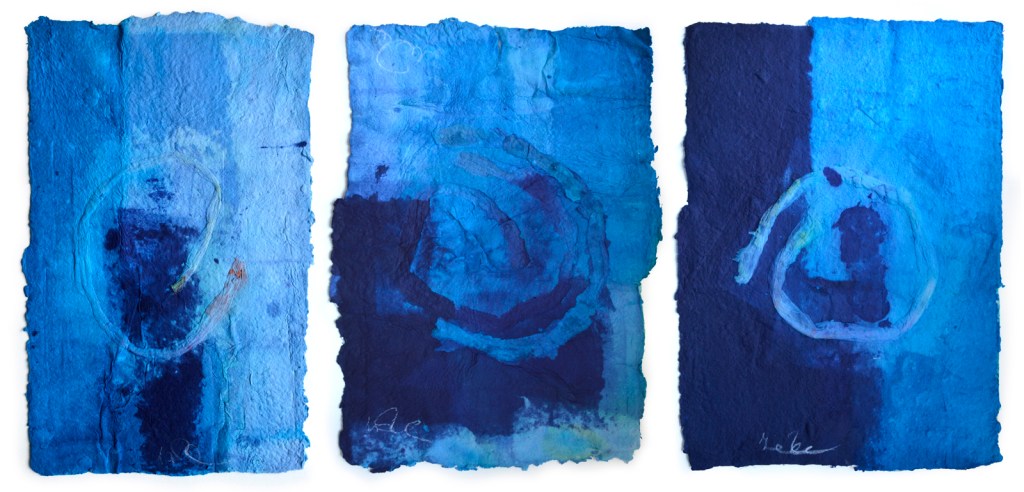
Earth is Calling reflects on the issues through a series of fibre art pulp works, contrasting natural, organic material with man-made plastic fibre. The artist will also present time-lapse and micro time-lapse works of melting ice embedded with natural and man-made items sourced from various locations (including along the Thames foreshore). The accompanying sound was created by musician and soundscape artist Jonathan Lambert.

The gallery, in the Crypt at St Pancras Church, is one of London’s most unique and atmospheric exhibition spaces. It’s located in the centre of London right opposite Euston Station

Il gioco della fontana (each piece approx 54 x 33 cm) 2018 triptich

Monster Soup 2019

Still from time lapse video work Monster Soup 2019

Monster Soup 2019 uses samples from different locations along the river to create projected time-lapses of melting frozen Thames water embedded with items found along the foreshore. A second microscopic time-lapse work shows what’s normally unseen with a focus also on micro fibre plastic and its potential impact on the environment. The accompanying sound track was created by musician and soundscape artist Jonathan Lambert.

In my work, I have always been preoccupied with nature and the environment, in large part due to my upbringing in the Italian Alps. Recently, my attention has shifted to issues concerning invisible nature, micro pollution and micro fibre plastic. My work explores ideas of transformation and adaptability in response to changes in temperature, landscape, boundaries, and the natural cycle.

The work will be shown at:
FORAGERS OF THE FORESHORE (Totally Thames Festival)
Bargehouse, Barge House Street, SE1 9PH
Wed 25 – Sun 29 Sep, 11am – 6pm

https://totallythames.org/event/foragers-of-the-foreshore


Outreach

As part of the R&D process for my current project, I recently delivered two outreach events with families and school children. We looked at micro fibre plastic under the microscope and discussed it’s implications on ecosystems and the environment.

Forensic scientist Pam Hamer was very helpful in suggesting ways to test the shedability of fibres from garments and came up with a quick easy and way for children to create their own ‘microscope slides’ using clear tape and a clear backing of OHP acetate. Polorised filters help to distinguish synthetic fibres such as polmeric ones from natural fibres such as wool and cotton. One identifying feature of some synthetic fibres is the fact that they’re hollow, identifiable at magnitudes of 10x or higher.

Towards the end of May, at Alexandra Park, I was joined my members of the Quekett Club (Dennis Fullwood and Paul Smith) and Friends of Alexandra Park to deliver a joint outreach initiative which looked at Diatoms, bugs and micro fibre plastic. Local families collected samples from the surrounding area and, in my case, looked for evidence of microfibres and examined fibres on clothing.

This month, I also delivered an artist talk and workshops to Year 6 students at Netley Primary School in Camden. I talked to the children about how my upbringing in the Dolomites has informed my artistic practice, especially in terms of environmental issues. I spoke about how I’m currently using microscopes as my artists’ tools to produce video outcomes that look at micro fibre plastics. I ran two workshops where we created our own microscopic slides using clear tape and acetate. We also talked about the importance of thinking and acting intelligently in order to protect the environment. I found the children to be very open to ideas of change in order to safeguard the environment.

Dale Fort Field Trip

As an artist, my final outcomes don’t claim to be research. They do aim to frame my area of interest as part of the climate change narrative in an non scientific way while referencing some of the recent findings. At the same time, I value the opportunity to engage with members of the scientific community and to participate in field study trips with groups such as the Quekett Club.

My current area of exploration is microfibre plastic.  I’m interested in the plastic that ‘disappears’ from the waste stream by being broken down into smaller and smaller particles. The problem now is not only how to reduce production of plastic but how to manage what’s already there – recycling just moves the problem along.

One area of concern is the presence of micro plastics in the ocean and it’s ingestion by organisms right down to plankton at the bottom of the food chain. Clothes made from synthetics are one source of microfibre plastics found in rivers, lakes and oceans. Millions of microfibres are released every time we wash these materials.

https://www.bbc.co.uk/news/science-environment-39217985
https://friendsoftheearth.uk/plastics/microfibres-plastic-in-our-clothes
https://www.theguardian.com/sustainable-business/2017/jun/29/microfibers-plastic-pollution-apparel-oceans

On a recent field trip to Dale Fort on the  Pembrokeshire coast, I was interested to see what I could find on the shoreline and in the water. There is the usual larger plastic items which ultimately will break down.

Looking at plankton using 10x and 20x lens – so showing slightly bigger examples -indicated fibres from fishing netting and plastic rope as would be expected.


Keyence VHX 5000 Microscope

Thanks to Matthew Armes, technical sales engineer for Keyence UK, who called round on Thursday to demonstrate the VHX-6000 Digital Microscope.

This is incredibly easy to use and is capable of real-time focus stacking.

Multi-angle observation by rotating the stage or tilting the lens up to 90 degrees means you don’t have the move the samples by hand. It produces images up to 1600 x 1200 – for higher res, automatic stitching is possible with the motorized stage.

Also good depth of field, embedded polarizing lens and really fast automatic focusing.

I had the opportunity to photograph some of my micro fibre plastic slides, melted snowflake and ice slides and lichens.

Images from clockwise: synthetic net bag for fruit produce, synthetic tights, melting ice, dried Lobaria Pulmonaria x 2, melting ice