Private View – Earth is Calling

PRIVATE VIEW
on Thursday 24 October, 6pm – 9pm
at The CRYPT GALLERY
165 Euston Rd, Bloomsbury, London NW1 2BA

Located in the crypt of St Pancras New Church
(access to the gallery along Duke’s Road, 2nd gateway)

Meet the artist – refreshments provided
We look forward to seeing you there

FREE EVENT
Exhibition times: 23 Oct – 3 November 2019 – 11 am – 7 pm

EARTH IS CALLING
Exhibition of new work by IRMA IRSARA
Featuring soundscapes by Jonathan Lambert

The focus of my work has shifted to invisible nature, micro pollution and micro fibre plastic, using micro-photography / film to produce my outcomes.

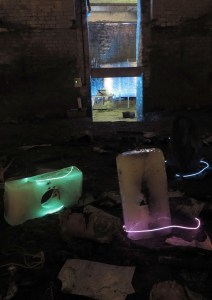
Earth is Calling reflects on the issues through a series of fibre art pulp works, contrasting natural, organic material with man-made plastic fibre. The artist will also present time-lapse and micro time-lapse works of melting ice embedded with natural and man-made items sourced from various locations (including along the Thames foreshore). The accompanying sound was created by musician and soundscape artist Jonathan Lambert.

The gallery, in the Crypt at St Pancras Church, is one of London’s most unique and atmospheric exhibition spaces. It’s located in the centre of London right opposite Euston Station
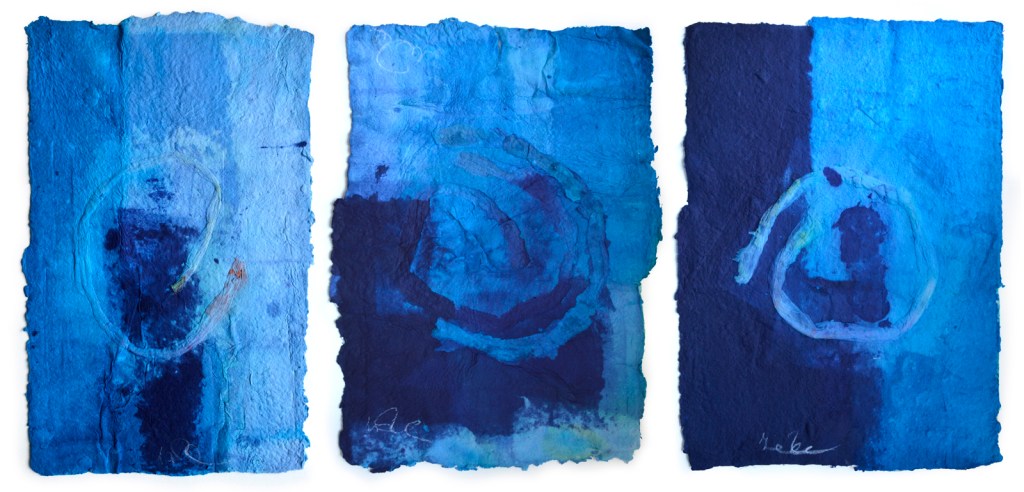
Il gioco della fontana (each piece approx 54 x 33 cm) 2018 triptich

Monster Soup 2019

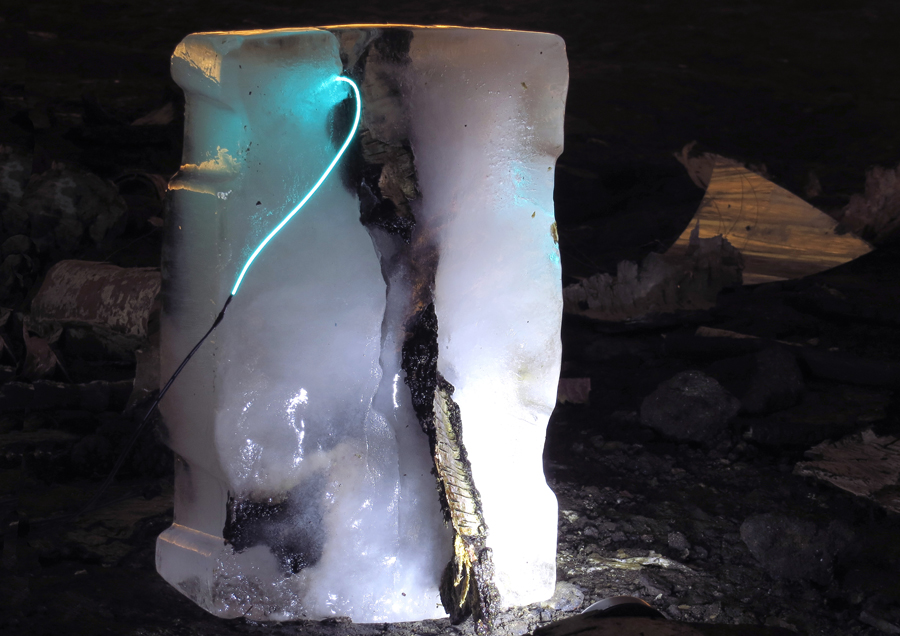
Still from time lapse video work Monster Soup 2019

Monster Soup 2019 uses samples from different locations along the river to create projected time-lapses of melting frozen Thames water embedded with items found along the foreshore. A second microscopic time-lapse work shows what’s normally unseen with a focus also on micro fibre plastic and its potential impact on the environment. The accompanying sound track was created by musician and soundscape artist Jonathan Lambert.

In my work, I have always been preoccupied with nature and the environment, in large part due to my upbringing in the Italian Alps. Recently, my attention has shifted to issues concerning invisible nature, micro pollution and micro fibre plastic. My work explores ideas of transformation and adaptability in response to changes in temperature, landscape, boundaries, and the natural cycle.

The work will be shown at:
FORAGERS OF THE FORESHORE (Totally Thames Festival)
Bargehouse, Barge House Street, SE1 9PH
Wed 25 – Sun 29 Sep, 11am – 6pm

https://totallythames.org/event/foragers-of-the-foreshore


Outreach

As part of the R&D process for my current project, I recently delivered two outreach events with families and school children. We looked at micro fibre plastic under the microscope and discussed it’s implications on ecosystems and the environment.

Forensic scientist Pam Hamer was very helpful in suggesting ways to test the shedability of fibres from garments and came up with a quick easy and way for children to create their own ‘microscope slides’ using clear tape and a clear backing of OHP acetate. Polorised filters help to distinguish synthetic fibres such as polmeric ones from natural fibres such as wool and cotton. One identifying feature of some synthetic fibres is the fact that they’re hollow, identifiable at magnitudes of 10x or higher.

Towards the end of May, at Alexandra Park, I was joined my members of the Quekett Club (Dennis Fullwood and Paul Smith) and Friends of Alexandra Park to deliver a joint outreach initiative which looked at Diatoms, bugs and micro fibre plastic. Local families collected samples from the surrounding area and, in my case, looked for evidence of microfibres and examined fibres on clothing.

This month, I also delivered an artist talk and workshops to Year 6 students at Netley Primary School in Camden. I talked to the children about how my upbringing in the Dolomites has informed my artistic practice, especially in terms of environmental issues. I spoke about how I’m currently using microscopes as my artists’ tools to produce video outcomes that look at micro fibre plastics. I ran two workshops where we created our own microscopic slides using clear tape and acetate. We also talked about the importance of thinking and acting intelligently in order to protect the environment. I found the children to be very open to ideas of change in order to safeguard the environment.

Dale Fort Field Trip

As an artist, my final outcomes don’t claim to be research. They do aim to frame my area of interest as part of the climate change narrative in an non scientific way while referencing some of the recent findings. At the same time, I value the opportunity to engage with members of the scientific community and to participate in field study trips with groups such as the Quekett Club.

My current area of exploration is microfibre plastic.  I’m interested in the plastic that ‘disappears’ from the waste stream by being broken down into smaller and smaller particles. The problem now is not only how to reduce production of plastic but how to manage what’s already there – recycling just moves the problem along.

One area of concern is the presence of micro plastics in the ocean and it’s ingestion by organisms right down to plankton at the bottom of the food chain. Clothes made from synthetics are one source of microfibre plastics found in rivers, lakes and oceans. Millions of microfibres are released every time we wash these materials.

https://www.bbc.co.uk/news/science-environment-39217985
https://friendsoftheearth.uk/plastics/microfibres-plastic-in-our-clothes
https://www.theguardian.com/sustainable-business/2017/jun/29/microfibers-plastic-pollution-apparel-oceans

On a recent field trip to Dale Fort on the  Pembrokeshire coast, I was interested to see what I could find on the shoreline and in the water. There is the usual larger plastic items which ultimately will break down.

Looking at plankton using 10x and 20x lens – so showing slightly bigger examples -indicated fibres from fishing netting and plastic rope as would be expected.


QUEKEX 2018

Captured irregular snowflakes (London 2018) on slides, one of which shows microfibre plastic which could be clearly seen during the melting process. It’s worth asking what sort of damage plastic fibres are doing.

Photos will be shown at the Quekett Microscopical Club Quekex exhibition at NATURAL HISTORY MUSEUM (foyer of the Flett Theatre), Cromwell Road, London SW7 5BD
Saturday 6th October 2018, 10.30am – 4pm
Invitation-only exhibition.

Working as a Woman Artist

Reflections on Working as a Woman Artist:
talk and visuals by Irma Irsara

DATE AND TIME: Thursday March 8 – 6:00 PM – 8:00 PM
LOCATION: Resource For London, 356 Holloway Road, London N7 6PA (map below)
BOOK TICKETS (free):
https://www.eventbrite.com/e/reflections-on-working-as-a-woman-artist-talk-and-visuals-by-irma-irsara-tickets-43618971518?

DESCRIPTION
Italian artist Irma Irsara has chosen International Women’s Day to talk about her experiences as a woman artist during a career that spans over 30 years. The event is being held in conjunction with her current exhibition at Resource for London: ‘Zero Celsius – Digital Prints’.

Irma will share her thoughts on growing up in a male dominated environment, the impact of gender politics on her time at the Accademia di Belle Arti in Urbino, and the current position of women artists in the art establishment.

She will reflect on her experiences, both positive and negative, with galleries, collectors, art consultants and art fairs, as well as exploring the idea of going the solo route versus connecting with peers through collectives. She will explore how the urgency of wanting to create art conflicted with the practical side of the business. She also had to re-think her practice after the birth of her children and considers the effect of motherhood on both the content of her art and her working practices.

Irma Irsara grew up on the foothills of Monte Croce in the Italian Dolomites and her work is heavily influenced by the natural environment. She has a special interest in ecology, conservation and climate change. As well as her artistic training at the Accademia di Belle Arti di Urbino in Italy, she studied Country Care and Conservation at Capel Manor Horticultural College in Enfield. Her practice encompasses a broad range of media and techniques, with ‘pulp work’ representing a large part of her recent output. She has lived and worked in London for many years and exhibits both in the UK and abroad.

Resource for London is where the voluntary sector comes to work, meet and exhibit. Owned by Trust for London and managed by the Ethical Property Company, all proceeds stay within the voluntary sector and are used to support groups tackling inequality in London while the Centre is managed to high environmental standards.

Zero Celsius – digital prints

My current exhibition is at Resource for London, 356 Holloway Road, London N7 6PA until 27th March ’18 – exhibition statement below.

“The transparency of the material leads me to look closer, almost searching for and imaginary landscape inside the heart of the ice. I find ice is very similar to other materials I have used in the past like glass, mirror and pulp. When light enters the artwork, it makes the edges more defined and frees the boundaries between artwork and the surrounding space.”

Irma Irsara‘s work is influenced by an interest in environmental issues in a practice that embraces techniques as diverse as fibre art, stained glass bookmaking, print, video and installation. Within the context of the Anthropocene Epoch, where human activity has been the dominant influence in altering the geographical landscape, Irsara contemplates ideas of  symbiosis as a strategy for human survival. The symbiosis of organic materials with the ice is particularly significant. It is the moment when nature takes over and the artist becomes the observer of new forms.

The digital prints on display are a permanent record of the time-based, site-specific installation work created by the artist in 2013/14. This constantly changing and daily-renewed work was produced over a three week period in the former Victorian ice wells at the London Canal Museum, King’s Cross. Working with ice, a material very much associated with the theme of climate change, the work explores natural cycles and outcomes in relation to surrounding conditions and is intended as a starting point for debate. She has a fascination with the medium, from the fusing together of forms to the slow, imperceptible movement of embedded material – bark, melinex, wire lights – as the melting process progresses. She also examines the possibility of producing hollow forms of ice by utilizing the natural freezing process. This is further explored in her more recent time-lapse pieces. Irsara is intrigued by the notion of a precise moment of transformation and change of state.

Drawing a Line Under Torture

Drawing a Line Under Torture, Freedom from Torture‘s biennial charity art auction takes place 8 November 2017 – 12 November 2017 at Bargehouse, Oxo Tower Wharf, South Bank, London

To bid on the work below and many other pieces, please follow the link:
http://ow.ly/6pCf30g8Ona

All works will continue to be on display until the close of the public exhibition and will be available for collection from Tuesday 14 November 2017

Freedom from Torture is a UK-based human rights organisation, and one of the largest torture rehabilitation centres in the world; it is the only specialist national charity working to ensure the rehabilitation and protection of torture survivors seeking refuge in the UK. Since it’s establishment in 1985, more than 57,000 survivors of torture have been referred to us.

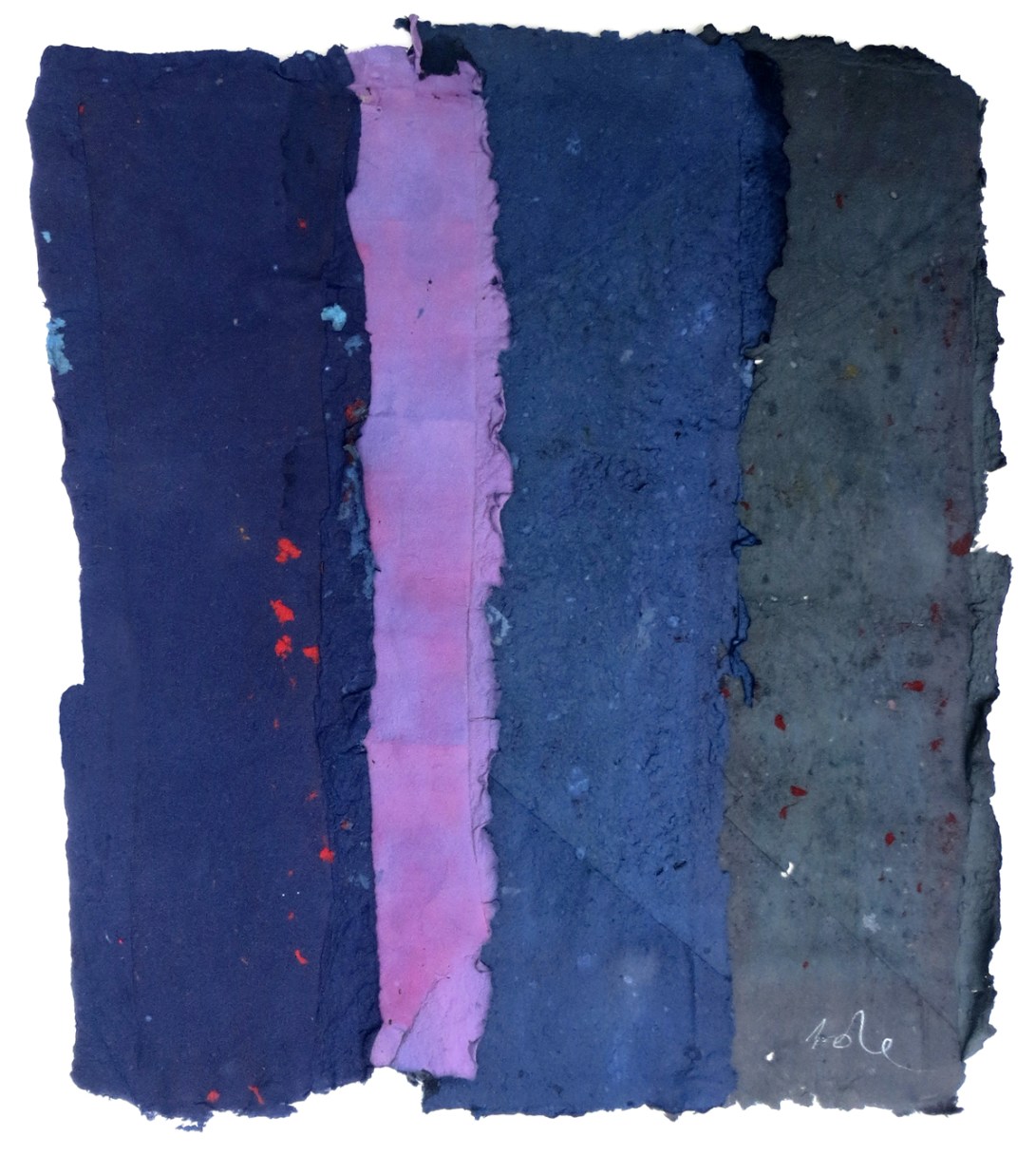
Fonte (Fount)
Cotton fibre pulps, direct dyes
52cm x 47cm
2017
Guide Price: £760
Framed

Irma Irsara’s work is heavily influenced by the natural environment in which she grew up – the foothills of Monte Croce in the Italian Dolomites. She has a special interest in ecology, conservation and climate change. ‘Fonte’ reflects an early childhood moment in a place revisited but now changed due to the effects of stream erosion. The title refers not only to rising water through cracks in the bedrock but also the idea of innocent thought set against the backdrop of succeeding stages of life.

Irsara’s practice encompasses a broad range of media and techniques with the ‘pulp work’ representing a large part of her recent output. The wet-on-wet process involves building up strata of dyed pulp which can be further modified through embedding, sculpting, ripping, embossing etc. She exhibits both in the UK and abroad.